
AI in export operations: eighteen use cases, scored
Based on recent implementation, we inventoried forty tasks an exporter performs, cut them to eighteen AI candidates, and scored every one. Here is the full ranking, the reasoning behind the top and bottom scores, and what changes at a different company size.
Four AI use cases clear both the value and feasibility bars for a mid-size exporter: cross-document consistency checking, partner discovery, market-entry research, and a landed-cost engine. All four are retrieval work over documents that already exist. The approach is applicable to any industry or activity.
Export is an unusually good fit for AI. Why? Because most export insights are already written down somewhere, in a tariff schedule, a letter of credit, a contract, a regulation. The work is finding it and assembling it. That is retrieval, an action that AI is very good at.
This analysis comes from two engagements: ExportAI, built with a North African client to find AI opportunities across export operations, and a consulting engagement with a UAE distributor moving electronics into African markets. We inventoried 40 tasks, cut them to 18 candidates, and scored every one.
How does an export operation actually work?
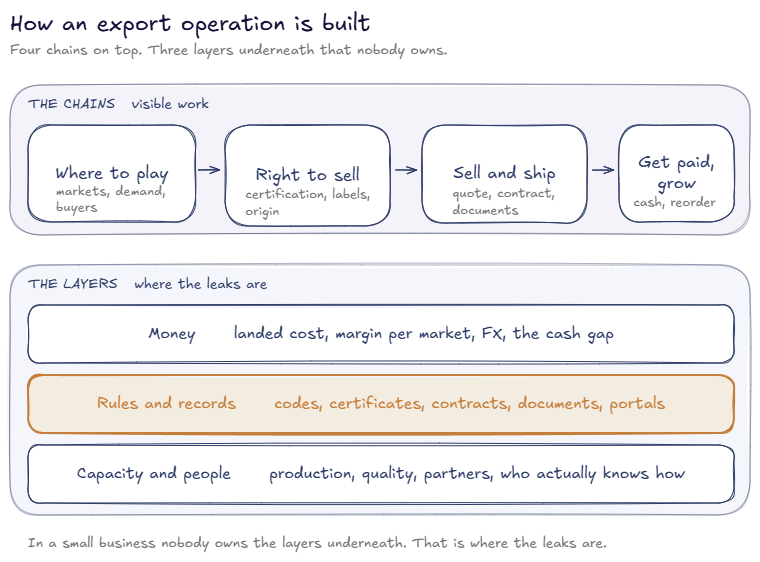
We first map the core activities of export operations. Four chains of activities of visible work sit on top of three layers that The chains are where to play, the right to sell, sell and ship, and get paid and grow. The layers are money, rules and records, capacity and people.
The first two chains happen once per market. The last two repeat forever, which is why they dominate the hours spent.
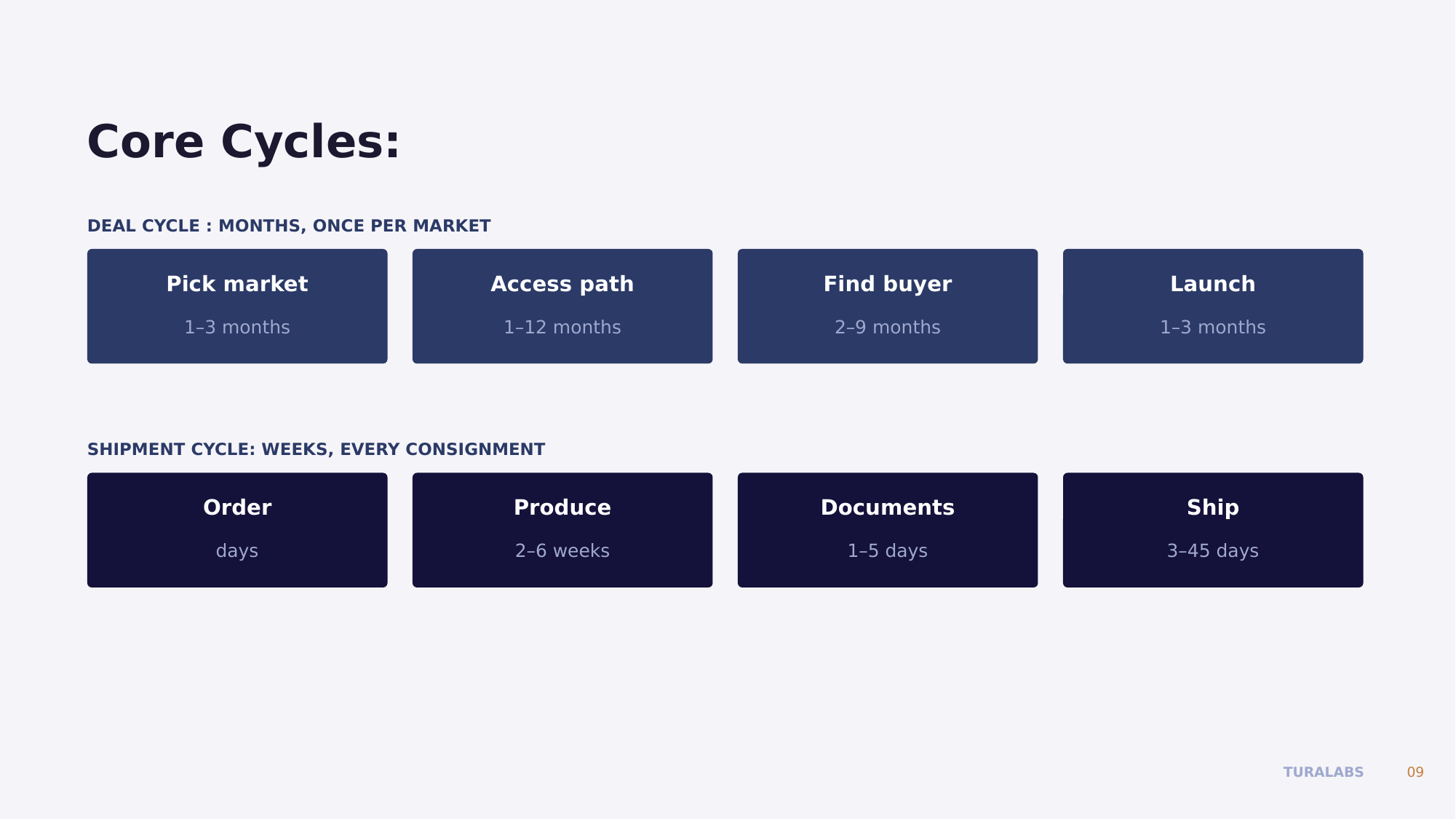
Behind both cycles sits a monitoring layer: market watch and regulatory watch. Six recurring jobs, all the same kind of work, searching scattered sources, reading unstructured documents, extracting facts and comparing against last time. High consequence, zero urgency. It usually does not get done, because the export team has no time for it, and that omission surfaces later as a shipment held at a border.
Five gates decide whether any of it works: can it legally enter, does the margin survive to the shelf, is there a channel that will actually sell it, will you get paid and can you fund the gap, and will it reorder.
Where does an export operation leak money?
In administration, not in logistics. Here is the data:
75%of the time it takes to get goods out of a country is administrative, not roads and not ports (Djankov, Freund and Pham, Trading on Time, World Bank). Each day of delay costs1%or more of trade.65-80%of bank document presentations are refused on the first attempt, unchanged since 2007 (ICC Banking Commission).- Non-tariff measures cost more than tariffs in
88%of countries, at3-4xthe tariff cost, and unnotified measures alone cost the equivalent of a28%tariff (UNCTAD, Global Trade Update, May 2026). - Delay is charged by the day:
$664per container per day on the global average (Container xChange). - Over
50%of new exporters stop exporting within a single year (Freund and Pierola; Eaton et al.).
The symptom an exporter reports is a shipment held at customs. The root cause is a document mismatch, a wrong HS code, or a missing certificate.
| Symptom | Root cause |
|---|---|
| Shipment held at customs | Document mismatch, wrong HS code, missing certificate |
| Letter of credit paid late or not at all | Discrepancies between documents and LC terms |
| Duty higher than quoted | Wrong classification, or preference never claimed |
| Market entry stalls | Certification path discovered too late |
| Sell-in strong, no reorders | No sell-out visibility or local demand creation |
| Locked out of a market | Exclusivity granted without performance clauses |
| Everything depends on one person | The process lives in one head, undocumented |
There is a second category that never shows up in a complaint log: what does not happen at all. Evaluating eight markets before committing to one, because each takes 30-100 hours of research. Quoting a landed price on request, because nobody can compute it reliably. Reaching out to buyers systematically, because there is no time and no list. These simply cap the business growth.
Which of that work can AI actually do?
We'll use a simple approach to find where AI can actually fit. We'll match each candidate to a technology by the verb, then be honest about the pairings that do not hold. Forty tasks came down to sixteen after removing judgement, relationship and physical work and cutting anything too small to matter. I added two more, because in practice a client or a department pushes for a specific solution whether or not the evidence supports it, and it is better to score those on identical criteria than to argue about them.
| # | Use case | Verb | Technology |
|---|---|---|---|
| 01 | Document generation | Generate + execute | Templating from one record, portal agents |
| 02 | Cross-document check | Perceive + retrieve | OCR and field-level reconciliation |
| 03 | LC pre-flight audit | Perceive + retrieve | Extraction, rule-check against the credit terms |
| 04 | Regulatory watchtower | Retrieve + monitor | Agentic monitoring, change summaries |
| 05 | Shipment requirements | Retrieve | Retrieval over a curated rule base |
| 06 | Market-entry research | Retrieve + generate | Retrieval over trade and regulatory sources |
| 07 | HS code and origin | Retrieve | Retrieval over tariff nomenclature |
| 08 | Landed-cost engine | Compute | Deterministic model, language interface |
| 09 | Partner discovery | Retrieve + generate | Agents, enrichment, scorecard |
| 10 | Sell-out scorecard | Perceive + execute | OCR and schema normalisation |
| 11 | Chase and dunning | Execute | Workflow automation with an approval gate |
| 12 | Multilingual collateral | Generate | Generative AI |
| 13 | Knowledge capture | Generate + retrieve | LLM over history, then retrieval |
| 14 | Expiry register | Execute | A table and a reminder |
| 15 | Label compliance | Perceive + retrieve | Vision against a per-market rule base |
| 16 | Drawback claims | Retrieve + generate | Retrieval and claim assembly |
| 17 | Demand forecasting | Predict | Classical machine learning |
| 18 | Bought predictive tools | Predict | Vendor model, subscribe |
Some comments on two tasks: The landed-cost engine is arithmetic with a language interface on top, barely AI at all, and that is exactly the point. The expiry register is a table and a reminder. Say so out loud rather than selling either one as intelligence.
Nothing factual should ever be generated. In a document engine, values, weights and codes are retrieved and transformed, never written by a model.
How were the eighteen scored, and for whom?
Four dimensions with stated weights, scored one to five against an company archetype: an exporter at roughly $2-5m in export revenue, around 10 consignments a month, 2-4 active markets, 1-3 people on export, an accounting system and no trade ERP, selling B2B through distributors, in a category that is not heavily regulated. Change the archetype and the ranking changes.
| Dimension | Weight | What it covers |
|---|---|---|
| Business value | 40% | Revenue, cost and time, risk avoided, decision quality |
| Feasibility | 35% | Data readiness, technical difficulty, integration, adoption |
| Risk when wrong | 15% | Consequence of an error and where the liability sits |
| Owner priority | 10% | Whether someone will sponsor it and actually use it |
What scored highest?
| Rank | Use case | Score |
|---|---|---|
| 1 | Cross-document check | 4.23 |
| 2 | Partner discovery | 4.12 |
| 3 | Market-entry research | 4.05 |
| 4 | Landed-cost engine | 4.02 |
| 5 | Expiry register | 3.94 |
| 6 | LC pre-flight audit | 3.77 |
| 7 | Shipment requirements | 3.71 |
| 8 | Document generation | 3.68 |
| 9 | Multilingual collateral | 3.66 |
| 10 | Bought predictive tools | 3.53 |
| 11 | Sell-out scorecard | 3.50 |
| 12 | Knowledge capture | 3.42 |
| 13 | Regulatory watchtower | 3.39 |
| 14 | Chase and dunning agent | 3.30 |
| 15 | HS code and origin check | 3.29 |
| 16 | Label compliance check | 3.21 |
| 17 | Demand forecasting | 2.88 |
| 18 | Drawback claims | 2.81 |
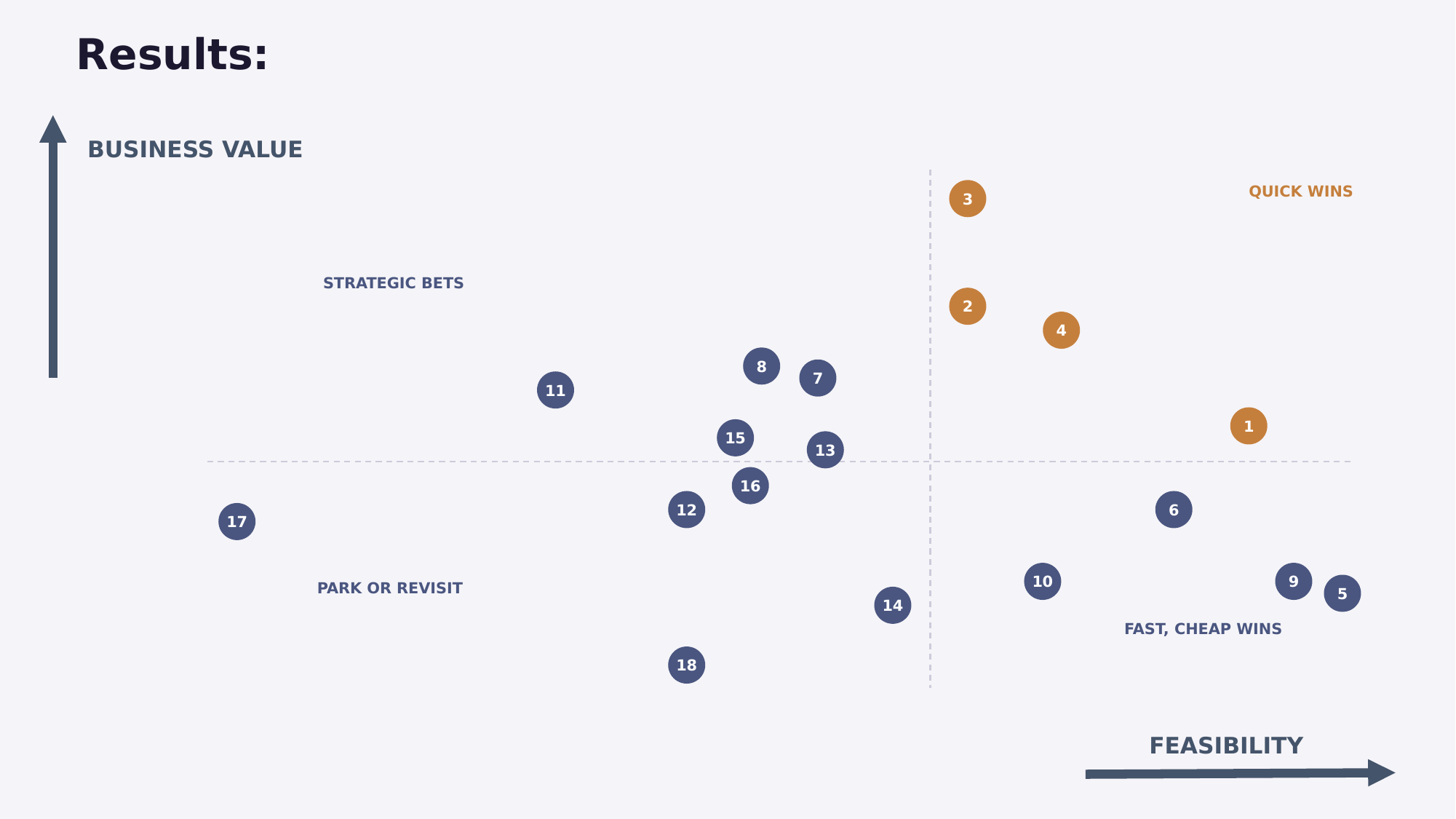
The top-right quadrant is where you start. Below it sit the fast, cheap wins, and sometimes we start there instead, because a client wants to see something quick and see the value of AI before investing more.
Market-entry research and partner discovery come up constantly in conversations with exporters, so the scoring confirmed what I expected going in. One caveat on partner discovery: exporters want partners who are reliable and who actually want to sell. The reliability part is not something AI does. Whether a company is solvent and trustworthy goes through third-party organisations.
Why did the top one win and the bottom one lose?
Because of data readiness and adoption friction.
The cross-document consistency check takes the finished document set and flags every mismatch in value, description, HS code, weights, carton counts, parties and dates before anything is submitted. It scores 3 on revenue, because it generates none, it protects existing revenue when a held container misses a season. It scores 5 on risk avoided, because it targets the two most expensive failure modes at once. It scores 5 on data readiness, because the documents are the input and there is nothing to build first. It scores 5 on integration, because it runs on a folder of files.
The score that decides it is adoption, also 5. It is appended to a step the team already performs, so it does not change their current behaviour. Changing behaviour means a lot of friction, and friction means it is less likely to be adopted. The technical score is 4 rather than 5 only because numeric extraction from stamped and scanned documents, a scanned receipt from a forwarder, needs care.
Demand forecasting is the opposite. It has the highest decision-improvement score of any candidate at 5, because good forecasts would genuinely matter. Then data readiness scores 1. A model that learns to predict needs hundreds to thousands of labelled examples, cases where you also know what happened afterwards. This company has around 120 consignments a year. And the markets you never entered produce no data at all.
Technical scores 2, custom modelling on thin data being the hardest build on the list. It also does not make sense for a company at this stage to forecast at all. It will make sense for a bigger one.
Does the ranking change with company size?
Yes, it all depends on your context.
| Starting out | Growing brand | Large operator | |
|---|---|---|---|
| What changes | Nothing to integrate with, but no capacity to learn tools | Real systems to integrate; volume justifies automation | Data readiness genuinely improves; scale justifies a rule base |
| Top three | Landed cost, document check, market research | Document engine, document check, watchtower | Rule base, classification, forecasting finally viable |
If you are starting out you do market research, identifying the right market and the right HS code. If you are a growing brand it moves to the document engine, the document check, and watching what is happening. A larger operator can automate more, because the processes have been run many times, and can finally justify forecasting, because the data exists.
To go further and look at the methodology I used to identify the use cases & prioritize: look into the blog article
Watch the full walkthrough
Frequently asked questions
What are the best AI use cases for an export business?
For a mid-size exporter, four cleared both the value and feasibility bars: cross-document consistency checking, partner discovery, market-entry research, and a landed-cost engine. All four are retrieval and reconciliation work over documents that already exist, which is why they are both valuable and quick to build.
Why does document checking outrank document generation?
Checking needs nothing built first. The documents are already the input, it runs on a folder of files, and it attaches to a step the team already performs, so nobody changes their behaviour. Generation needs a clean source record and touches more systems, which lowers feasibility even though its cost saving is larger.
Can AI forecast export demand?
Not at this size. A model that learns to predict needs hundreds to thousands of labelled outcomes, and an exporter running around 120 consignments a year does not have them. The markets you never entered produce no data at all. Forecasting scored lowest of the eighteen on data readiness.
Which parts of export work should be done by humans?
Choosing a market, choosing a partner, setting price, and negotiation. AI can assemble the evidence and build the shortlist, but the decision stays human. Partner reliability in particular is not something AI verifies; that goes through third-party organisations that check whether a company is solvent.
Does the ranking change for a smaller or larger exporter?
Substantially. A company starting out ranks landed cost, document checking and market research first, because it has nothing to integrate with. A large operator ranks a rule base and classification first, and is the only size at which demand forecasting becomes viable, because scale finally produces enough data.
What's next
I am planning to run this same analysis on other lines of business.
If you want an audit like this one done on your own business or professional activity, book a strategy call.
How to turn one video into a week of LinkedIn posts with AI (using free tools)
NextWhere AI actually fits: a five-step method, worked on export operations
Related articles
How to make presentations with AI the right way
I have been building client proposals for thirteen years. Here is the workflow I use to make an effective presentation with AI without ending up with generic slides.
Where AI actually fits: a five-step method, worked on export operations
A repeatable way to find where AI belongs in a business: map the activity, size the pain with sourced numbers, match the work to the technology, then score the options on criteria you can argue with. Worked end to end on export.
How to turn one video into a week of LinkedIn posts with AI (using free tools)
A step-by-step workflow for turning one recorded video into ten to thirty LinkedIn posts that still sound like you from a transcript, AI-assisted idea extraction, and post drafts, in that order.